Most adults with clear sleep apnea symptoms and no serious heart or lung disease should start with a home sleep test. An in-lab sleep study is the better choice when another sleep disorder is suspected, when medical complexity is involved, or when a home test comes back negative despite strong symptoms.
These two tests get talked about as competitors. They are closer to different tools for different jobs. One counts breathing events cheaply and conveniently in your own bed. The other records almost everything your body does overnight, in a facility, with a technologist watching the signals in real time.
For a large share of people with suspected obstructive sleep apnea, the cheap convenient version is genuinely enough, and sleep medicine guidelines say so. For a smaller group it is the wrong test, and using it wastes weeks and can produce a falsely reassuring result. Which group you fall into depends less on preference than on your symptoms and the rest of your medical history.
The short comparison
| Home sleep test | In-lab sleep study | |
|---|---|---|
| Also called | HSAT, home sleep apnea test | Polysomnography, PSG |
| Where you sleep | Your own bed | A sleep lab bedroom |
| Sensors | Roughly 3 to 6, worn on the body: breathing effort, oxygen, pulse, position and snoring, plus airflow on older tube-based devices | Roughly 20 or more, including brain waves, eye movement, muscle tone, heart rhythm, leg movement, and video |
| Measures actual sleep | Estimated from movement at best. No brain wave recording, so no true sleep staging | Yes, minute by minute, including sleep stages |
| Reports | An event index per hour. Devices with no sleep tracking divide by recording time, which reads low | Apnea-hypopnea index, based on measured sleep time |
| Detects other sleep disorders | No | Yes: limb movement disorders, REM behavior disorder, parasomnias, seizure activity |
| Supervision | None. You set it up yourself | A technologist monitors all night and can fix sensors |
| Typical self-pay cost | About 100 to 500 dollars. The FixSnoring test is 99 dollars flat | Frequently 1,000 to 3,000 dollars or more |
| Typical wait | Days to about two weeks | Often weeks, sometimes months |
| Main weakness | Arousal-only events go uncounted, so milder apnea can be missed entirely | Cost, access, and sleeping in an unfamiliar room |
What a sleep lab records that a home test cannot
The gap between the two tests is mostly the sensors on your head. A lab study adds EEG electrodes for brain waves, sensors at the eyes for eye movement, and a chin muscle sensor. Together those three tell a scorer exactly when you fell asleep, which stage you were in, and whether a breathing event pulled you toward waking.
That gives a scorer several things a home recording cannot deliver:
- Real sleep time. Events get divided by the hours you genuinely slept, measured minute by minute rather than estimated from how much you moved
- Arousal-based events. Breathing events that fragment sleep without dropping your oxygen get counted, and those are invisible to a home device
- Sleep architecture. How much deep and REM sleep you got, and whether your events cluster in REM, which is common
- Other diagnoses. Leg sensors catch periodic limb movements, video catches acting out dreams, and the EEG catches seizure activity
- Rescue during the night. A technologist reattaches a sensor that falls off instead of you discovering a dead channel days later

A lab study has one real disadvantage beyond cost. Sleeping in a strange bed with wires attached changes how you sleep, an effect researchers call the first-night effect. A home test measures a more typical night, which is a genuine scientific advantage that partly offsets its thinner sensor set.
When a home sleep test is enough
Sleep medicine guidelines support starting at home when three conditions hold at once: you are an adult, your symptoms point toward uncomplicated moderate to severe obstructive sleep apnea, and you have no significant cardiopulmonary or neuromuscular disease.
In practice that describes a lot of people, roughly this profile:
- Loud habitual snoring, ideally with pauses somebody has witnessed
- Daytime sleepiness or unrefreshing sleep after adequate time in bed
- Risk factors such as extra weight, a thick neck, middle age, or high blood pressure
- No heart failure, chronic lung disease, or neuromuscular condition
- No reason to suspect a sleep disorder other than apnea
If that is you, a home test is faster, cheaper, and likely to give a usable answer. Details of the night itself are in our guide to how a home sleep test works.
Two things worth checking about whichever home test you are offered. First, the device class: the FixSnoring test is an FDA-cleared Level 3 home sleep apnea test, which is the category sleep medicine guidelines endorse for uncomplicated suspected moderate to severe apnea. Second, who reads it. Every FixSnoring study is scored and interpreted by a board-certified sleep physician rather than handed back as an app score, and the kit ships with a prepaid return label so there is nothing to arrange at the end.
When you need an in-lab sleep study
Several situations call for the lab from the start, because a home test either cannot answer the question or would answer it unreliably:
- Significant heart or lung disease. Heart failure, coronary disease, COPD, or any condition where oxygen levels and carbon dioxide need closer monitoring
- Neuromuscular disease. Weak respiratory muscles change how breathing fails, and home devices are not validated for it
- Suspected underbreathing at night. If carbon dioxide is building up rather than oxygen simply dipping, a home test will miss the mechanism
- Long-term opioid use. These medications can drive central events that need effort and brain wave signals to characterize
- Suspected central sleep apnea. Especially alongside heart failure or after a stroke
- History of stroke. Higher complexity and a higher rate of mixed and central events
- Suspicion of a different sleep disorder. Narcolepsy, REM behavior disorder, restless legs with limb movements, or unexplained night-time behavior
- Severe insomnia. Very little actual sleep makes an unattended recording hard to interpret
- Titration in a lab. Some treatment setups are still calibrated overnight with a technologist adjusting pressure
- Children. Pediatric testing is its own specialty with different thresholds
Read that list as a description of complexity rather than severity. Very severe apnea in an otherwise healthy adult is often diagnosed perfectly well at home.
Cost and wait time, compared honestly
Cost is the most common reason people choose a home test, and the gap is large. The FixSnoring test is 99 dollars flat with the physician interpretation included, FSA and HSA eligible, and no referral is needed to order it. A lab study before insurance often runs into the thousands, and facility pricing varies enormously between regions and hospitals.
Insurance adds a wrinkle worth knowing before you ask for one or the other. Many plans require a home test first for uncomplicated suspected sleep apnea, and will only authorize a lab study if you meet specific criteria or the home test fails to settle things. Asking your doctor to skip straight to the lab often means documenting why you fit one of the categories above.
Wait time follows the same pattern. Home devices ship in days. Lab beds are limited, and in many areas the wait is measured in weeks or months, which is the practical reason home testing became the default rather than the exception.
What if your home test is negative but you still have symptoms?
Take the symptoms more seriously than the test. No home device records brain waves, so breathing events that fragment your sleep without dropping your oxygen never get counted, and devices with no sleep tracking further dilute the number by dividing across the hours you lay awake. Both flaws push the result downward, so false negatives are the expected failure mode.
A normal home result in someone with witnessed pauses, real daytime sleepiness, or resistant high blood pressure is not a clean bill of health. The standard next step is a lab study, and clinical guidelines say precisely that: a negative, inconclusive, or technically inadequate home test in a symptomatic patient should be followed by polysomnography.
Worth knowing too that event counts genuinely vary night to night. Sleeping position, alcohol, nasal congestion, and how much REM sleep you got can all move a borderline number across a severity line.
What is a split-night study?
A split-night study is one lab night doing two jobs. The first half diagnoses: sensors record your untreated breathing. If the event count crosses a threshold early enough, usually well into the severe range within the first couple of hours, the technologist wakes you, fits a mask, and spends the second half finding the pressure that holds your airway open.
That saves a night and a bill compared with two separate studies. It only works if your apnea shows up quickly and clearly, so people with milder or position-dependent apnea usually need the full diagnostic night first.
Home sleep test vs sleep study: which should you ask for?
Start with the honest version of your own history rather than a preference. If you snore, wake up tired, have symptoms that cluster, and are otherwise reasonably healthy, ask about a home test, because it is faster and cheaper and will probably answer the question.
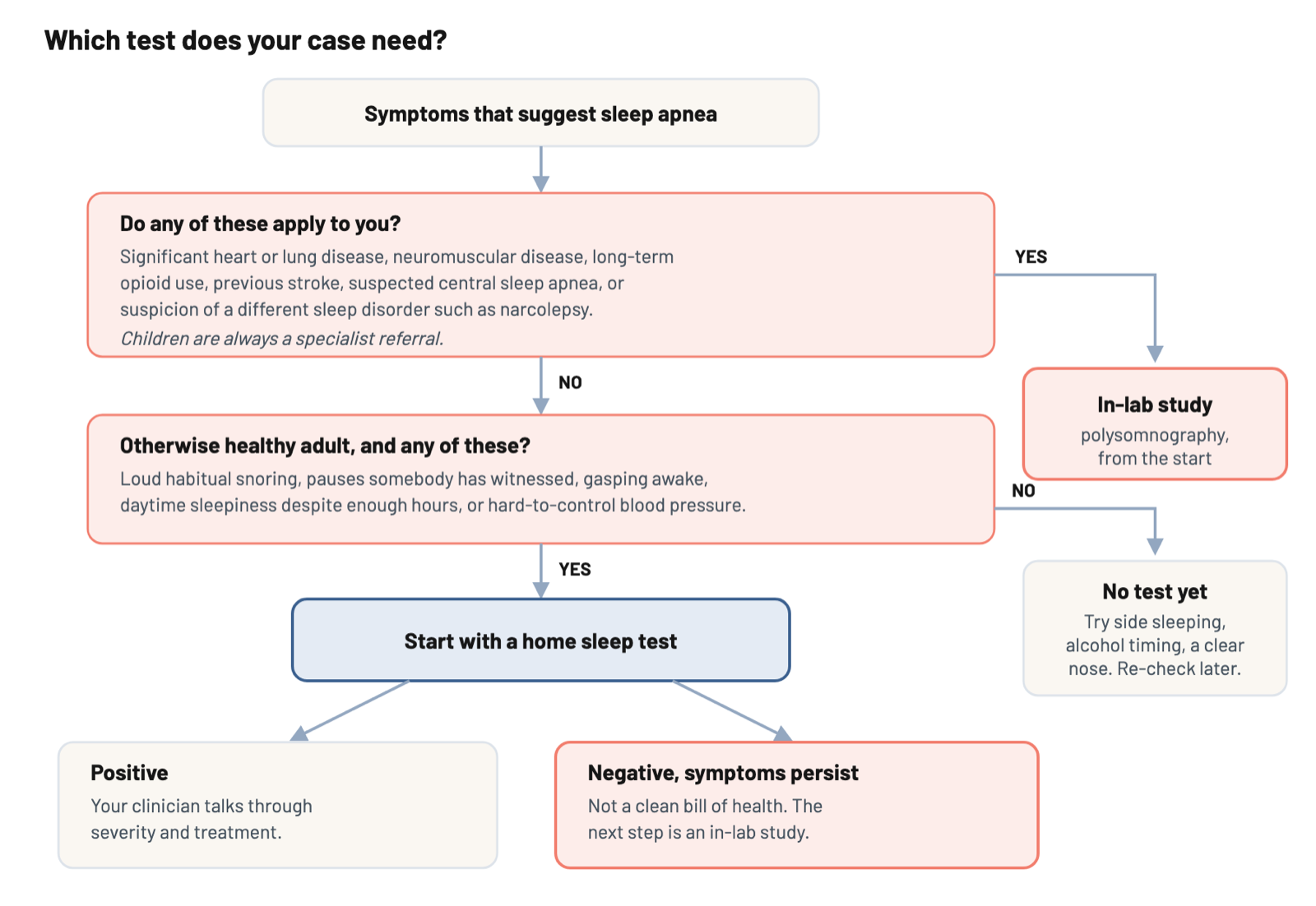
If you have heart or lung disease, take opioids, have had a stroke, or your nights involve anything stranger than snoring and gasping, say so plainly to your clinician and ask whether the lab is the right first stop. And if you already did a home test that came back clean while you still feel wrecked every afternoon, that is the moment to push for polysomnography rather than accepting the result.
Common questions
Is a home sleep test as accurate as a sleep study?
No, and it is not meant to be. In-lab polysomnography is the reference standard because it measures actual sleep time and detects arousals, while a home test estimates from fewer signals and tends to underestimate severity. For adults with clear symptoms of moderate to severe obstructive sleep apnea, that gap is small enough that guidelines endorse home testing as a first step.
Can a home sleep test miss sleep apnea?
Yes. Milder apnea and events that disturb sleep without dropping blood oxygen are the cases most likely to be missed. A negative home test alongside persistent symptoms is a reason for an in-lab study rather than a reason to stop investigating.
Which test does insurance prefer?
Most plans, including Medicare, favor home testing first for uncomplicated suspected obstructive sleep apnea because it costs far less. Lab studies are usually authorized when specific clinical criteria are met or when a home test was negative or inconclusive. Check your own plan's prior authorization rules before booking either one.
Do I have to sleep in a lab to get a CPAP prescription?
Not usually. A home sleep test that confirms obstructive sleep apnea is generally sufficient for a clinician to prescribe therapy, and auto-adjusting devices have reduced how often a separate in-lab titration night is needed. Some situations still call for lab titration, which is a decision for your treating clinician.
How long does an in-lab sleep study take?
You typically arrive in the evening, spend an hour or two having sensors applied, sleep overnight, and leave early the next morning. The whole visit runs about 10 to 12 hours, most of it asleep. Results usually come back within one to three weeks after a physician scores and interprets the recording.
Can I request an in-lab study instead of a home test?
You can ask, and whether it is approved depends on your clinical picture and your insurer's rules. Bring specifics: existing heart or lung conditions, medications, stroke history, or symptoms that suggest something other than apnea. Those details are what justify going straight to the lab.
What to do next
For most people who snore, wake up unrefreshed, and have no complicating conditions, the sequence is simple. Test at home first. Treat a negative result as provisional if your symptoms are strong, and move to the lab if the question stays open.
The American Academy of Sleep Medicine publishes patient guidance on both test types if you want to read the clinical framing yourself. If you are still weighing whether to test at all, the two-minute sleep quiz answers that faster. When you are ready for the measurement itself, start with a home sleep test, and if it is apnea the diagnosis and prescription arrive in the same report.
This article is for general education and is not medical advice. Sleep apnea can only be diagnosed by a licensed clinician using a sleep study they order and interpret.