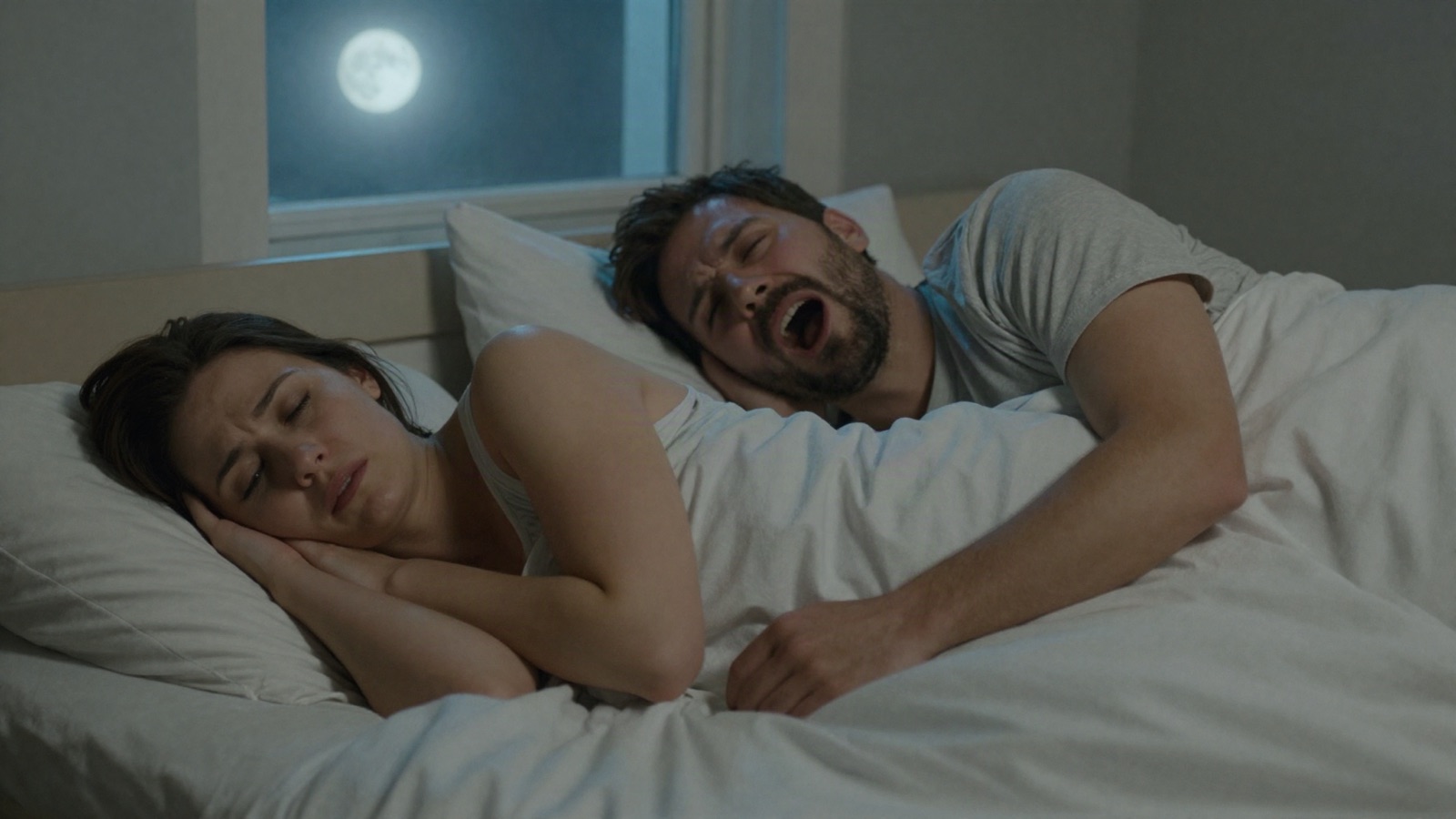
You snore because air has to squeeze past tissue in your throat that has gone slack. The soft palate, the uvula, and the base of your tongue vibrate as air pushes by, and that vibration is the sound you hear. Anything that narrows the airway further, from a blocked nose to a glass of wine, makes it louder.
Snoring is common enough that most people file it under personality rather than symptom. Population research puts habitual snoring at roughly 40 percent of adult men and 25 percent of adult women, so if you snore most nights you are in very ordinary company.
Common is not the same as harmless. For plenty of people, snoring really is just noise, a mechanical quirk of a relaxed airway. For others it is the audible edge of something measurable: an airway that is not simply narrowing but closing, over and over, for hours. The sound can be identical in both cases, which is why you cannot sort yourself into the right group by listening.
Here is what produces the noise, which causes are worth checking, and the specific signs that separate ordinary snoring from the kind that deserves a test.
What actually makes the sound?
While you are awake, muscles in your throat hold the airway open without you thinking about it. As you fall asleep, those muscles relax. The passage gets floppier and narrower, and air moving through a narrow, slack tube stops flowing smoothly. It turns turbulent, and the loose tissue begins to flutter.
The parts doing the vibrating are the soft palate at the back of the roof of your mouth, the uvula hanging from it, the walls of the throat, and in some people the base of the tongue. Which tissue is involved changes the sound. Palatal flutter gives you the classic rattling buzz, while tongue-base snoring runs lower and growlier, and nasal snoring sits higher and whistles.
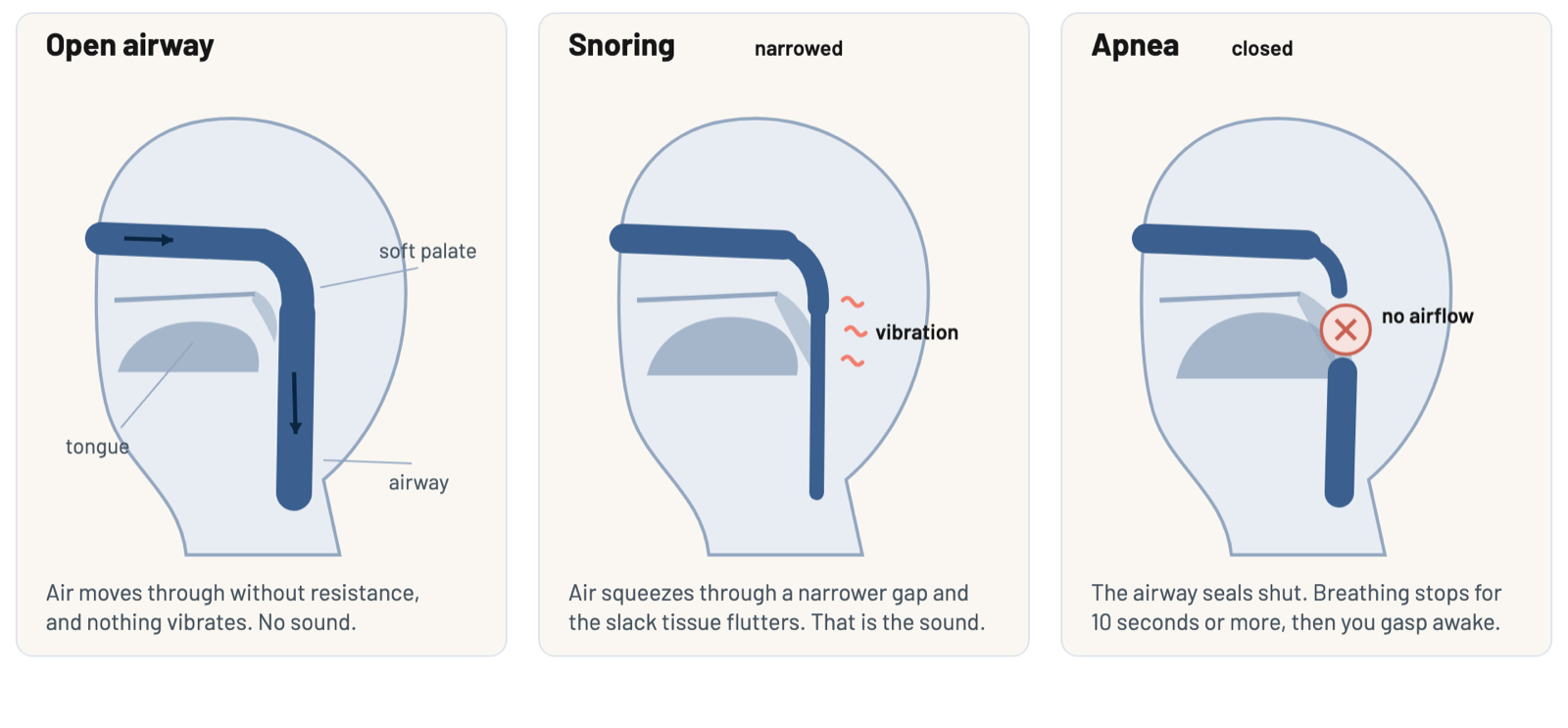
Volume tracks how tight the gap is. Faster air through a narrower opening means more turbulence, which is part of why snoring gets louder later in the night as muscle tone drops further.
Why do I snore every night?
Nightly snoring almost always comes down to one piece of fixed anatomy plus something that makes it temporarily worse. The anatomy explains why it happens at all. The variable factors explain why some nights are so much louder than others.
| Cause | What it does to the airway |
|---|---|
| Your anatomy | A small or set-back jaw, a long soft palate, large tonsils, a thick neck, or a high narrow palate leave less room to start with. Anatomy does not change from night to night, which is why the snoring is nightly. |
| Blocked nose | A deviated septum, polyps, allergies, or a head cold push you into mouth breathing, which lets the jaw and tongue fall backward. |
| Sleeping on your back | Gravity draws the tongue and soft palate toward the back of the throat. |
| Evening alcohol | Relaxes the muscles holding the airway open, on top of the relaxation sleep already causes. |
| Sedatives and muscle relaxants | Same mechanism as alcohol, lasting most of the night. |
| Extra weight | Fat deposits around the neck press inward on a passage that is already soft. |
| Age | Throat muscle tone declines, so the airway grows floppier through middle age. |
| Smoking | Inflames and swells the airway lining, closing a tight passage further. |
| Menopause | Snoring in women climbs after menopause as estrogen and progesterone fall and airway muscle tone drops with them. |
Most nightly snorers carry one structural cause with a behavioral one stacked on top. That is why a Tuesday sounds different from a Saturday, and it is the easiest place to see whether the noise responds to anything at all.
Why is it worse when I sleep on my back?
Lying on your back lets gravity pull your tongue and soft palate straight toward the back of your throat, which narrows the airway at the exact spot where snoring is generated. Roll onto your side and the tongue falls sideways instead of backward, and the passage opens.
Some people snore only on their back, which sleep specialists call positional snoring, and it is worth knowing which camp you fall into. When side sleeping silences you completely, position is doing most of the work. Snoring that follows you into every position points to something structural instead.
Breathing interruptions can be positional too. Plenty of people have what clinicians call positional apnea, where the events cluster heavily in the hours spent on their back. A home sleep test records body position alongside your breathing, so it shows not just whether you have a problem but where in the night it happens.
Is snoring harmful, or just annoying?
That depends entirely on whether your breathing is being interrupted, and the snoring itself does not tell you. Two very different things produce a similar sound.
Primary snoring is vibration without meaningful consequence. Air still moves, oxygen holds steady, and your sleep is not fragmented, so the main cost lands on whoever sleeps next to you. Whether decades of heavy snoring carries risk by itself is still an open research question.
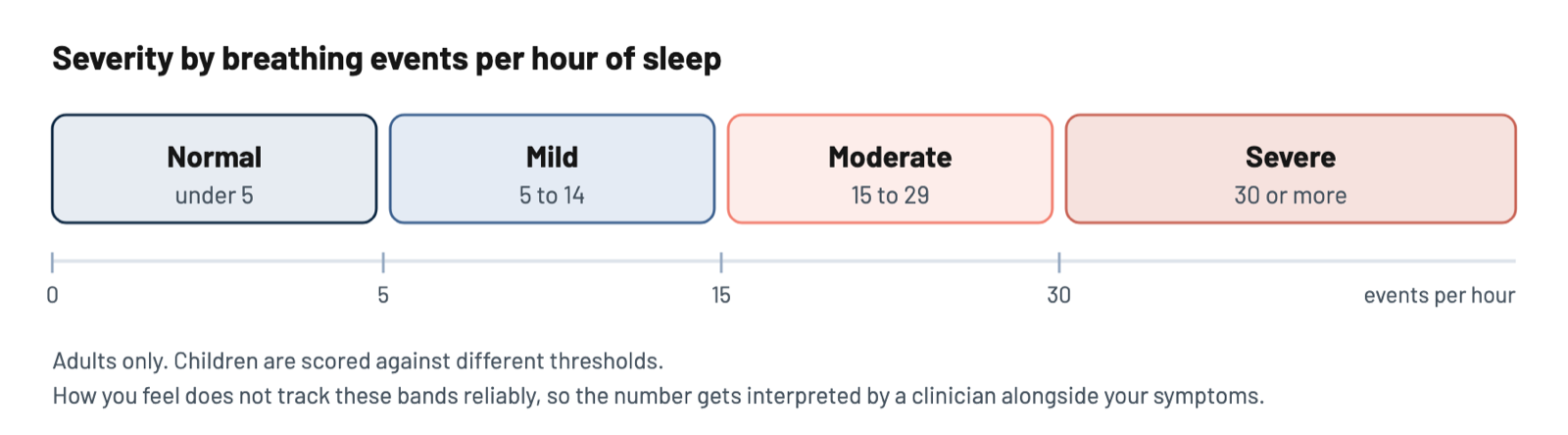
Obstructive sleep apnea is the airway actually collapsing. An apnea is a near-total blockage lasting at least 10 seconds. A hypopnea is a partial one, a drop of 30 percent or more in airflow, paired with a dip in blood oxygen or a brief awakening. Each event ends with a surge of stress hormones and an arousal you will not remember. At 30 events an hour, that is roughly 240 interruptions across an eight-hour night.
An estimated 30 million American adults have obstructive sleep apnea, and around 80 percent of them do not know it. That is not a scare statistic. It is simply what happens with a condition whose symptoms occur while you are unconscious.
Untreated sleep apnea is associated with high blood pressure, atrial fibrillation, stroke, type 2 diabetes, and a raised risk of falling asleep at the wheel. That is the reason the distinction matters, and it is the whole argument for measuring rather than guessing.
Worth saying plainly in both directions: you can snore like a chainsaw with no apnea at all, and you can have significant apnea while barely snoring. Neither the volume nor the silence settles it.
The signs that snoring is more than noise
The useful signal is not the snoring itself. It is what shows up alongside it, at night and during the day. Look for these signs of sleep apnea:
- Someone has watched you stop breathing, or heard you gasp or choke awake
- You wake most mornings with a bone-dry mouth or a raw throat
- Morning headaches across the front of the head that fade within an hour or two
- A full seven or eight hours of sleep that leaves you feeling like you got none
- Daytime sleepiness you have to fight: nodding off reading, in meetings, at a red light
- Getting up to urinate twice or more a night
- High blood pressure, or blood pressure needing more than one medication
- Trouble concentrating, a shorter fuse, or low mood you have blamed on stress
- Waking suddenly with your heart pounding
A single item on that list is weak evidence, but three or more together is the pattern worth measuring. The most valuable information usually comes from your partner, who is awake for the part you sleep through. Ask them about the silences. A long gap that ends in a gasp is the finding that matters.
Should you get tested?
Not everyone who snores needs a sleep study. Testing earns its place when snoring comes with a cluster of the signs above, when someone has witnessed you stop breathing, when you are sleepy during the day despite enough hours in bed, or when you have high blood pressure that is hard to control.
The usual first step is a home sleep test. You sleep in your own bed wearing a small recorder that tracks airflow, breathing effort, blood oxygen, and pulse. A clinician orders it, reads the data, and turns it into a number of breathing events per hour.
Two honest limits. No home device records brain waves, so breathing events that fragment your sleep without dropping your oxygen cannot be scored, and older devices with no sleep tracking dilute the count further by dividing across the hours you lay awake. Either way the number tends to underestimate how severe the problem is. And a negative home test in someone with strong symptoms does not close the question. It usually leads to an in-lab study rather than a shrug.
Some people should skip straight to the lab. Significant heart or lung disease, muscle weakness from a neuromuscular condition, suspected shallow breathing from another cause, long-term opioid use, a history of stroke, or a suspicion of a different sleep disorder all call for full in-lab testing instead.
If you snore and have none of the warning signs, starting with sleep position, alcohol timing, and a clear nose is reasonable, then testing if the snoring persists or daytime symptoms appear.
What quiets simple snoring, and what it will not fix
For snoring without breathing interruptions, a few things genuinely help: side sleeping if your snoring is positional, three or four hours between your last drink and bed, clearing nasal congestion so you can breathe through your nose, and raising the head of the bed. Losing weight lowers both snoring and apnea severity in people carrying extra around the neck and middle, though it rarely resolves moderate or severe apnea by itself.
Now the part that gets skipped. None of this is treatment for sleep apnea, and a quieter night does not mean the apneas stopped. This is the real hazard of chasing the noise: an anti-snoring device or habit can mute the sound while the airway keeps collapsing, and it takes away the one warning sign you had. If you have any of the red flags, get the measurement before you silence the symptom.
Common questions about snoring
Is snoring always a sign of sleep apnea?
No. Most people who snore do not have sleep apnea, and some people with apnea barely snore at all. Snoring is a sound made by a narrowed airway, while apnea is that airway closing enough to interrupt breathing. Only a sleep study can tell you which one is happening.
Can you have sleep apnea without snoring?
Yes. Snoring is absent in some people with obstructive sleep apnea, and it is usually absent in central sleep apnea, where the brain briefly stops signaling the muscles to breathe. Women are more likely than men to have apnea without loud snoring, which is one reason their diagnosis is often delayed.
Why do I snore only when I sleep on my back?
On your back, gravity pulls your tongue and soft palate toward the rear of your throat and narrows the airway where snoring is produced. Snoring that stops completely on your side is called positional snoring. Breathing interruptions can be positional too, so side sleeping quieting the noise does not rule apnea out.
Does snoring get worse with age?
Usually yes, through middle age, because muscle tone in the throat declines over time and leaves the airway floppier. In women, snoring becomes noticeably more common after menopause as estrogen and progesterone fall. Snoring that suddenly worsens is worth mentioning to a doctor.
Will losing weight stop my snoring?
Weight loss reduces snoring and lowers apnea severity in people carrying extra weight around the neck and abdomen, so it is genuinely worth doing. It does not reliably eliminate moderate or severe sleep apnea on its own. Thin people snore too, usually because of the shape of their airway rather than their weight.
Is it worth recording myself at night?
A phone recording or a snoring app is useful for one specific thing: showing you and your doctor whether there are long silences between the snores and whether those silences end in a gasp. It cannot measure your blood oxygen or count breathing events. Treat it as a reason to get tested rather than a test.
What to do next
Snoring on its own is a nuisance. Snoring alongside witnessed pauses, unrefreshing sleep, or daytime sleepiness is a question with an actual answer, and that answer is a number rather than an opinion.
A home sleep test is the shortest distance between suspicion and that number: one night, your own bed, a small recorder, and a board-certified sleep physician who reads the result rather than an algorithm. The National Heart, Lung, and Blood Institute has the clinical background if you want it first.
Not sure you are in that group? The two-minute sleep quiz sorts out whether testing is worth it. If two or three of the warning signs above sounded familiar, skip ahead and start with a home sleep test: 99 dollars flat, FSA and HSA eligible, no referral needed, and if it is apnea the prescription comes with your report.
This article is for general education and is not medical advice. Sleep apnea can only be diagnosed by a licensed clinician using a sleep study they order and interpret.