A home sleep test is a small recorder you wear for one night in your own bed to find out whether your breathing stops while you sleep. It tracks airflow, breathing effort, blood oxygen, and pulse. A clinician orders it, a sleep physician reads the recording, and the result is the number of breathing events you have per hour.
For decades, finding out whether you had sleep apnea meant a night in a sleep lab wired to about two dozen sensors while a technician watched from another room. That test still exists and it is still the most complete one available. It is also expensive, often booked out for weeks, and hard to sleep through.
A home sleep test, which clinicians call a home sleep apnea test or HSAT, strips the equipment down to the sensors needed to answer one question: is your breathing being interrupted, and how often. You do it in your own bed on a normal night. It costs a fraction of a lab study, and for most people with straightforward symptoms it is now the standard first step.
What follows is what the device records, what it cannot see, how the night actually goes, and how a night of squiggly lines becomes a diagnosis.
What does a home sleep test measure?
Home sleep tests come in two shapes, and which one you get changes what the report can say. Older Type III devices measure airflow directly with a soft tube under the nose plus an elastic belt and a finger probe. Newer patch systems use two adhesive sensors plus a finger clip instead, with no tube at all, and derive airflow from those signals rather than measuring it at the nose.
| Sensor | What it records |
|---|---|
| Nasal cannula or airflow sensor | A soft tube under your nose measuring pressure changes as you breathe, which shows when airflow drops or stops. |
| Elastic effort belt around the chest or abdomen | Whether your body is still trying to breathe during a blocked breath. This is what separates an obstructive event from a central one. |
| Fingertip or wrist pulse oximeter | Blood oxygen saturation and pulse rate, so each event can be matched to the oxygen drop it caused. |
| Position sensor | Which way you were lying, which reveals whether your events happen mainly on your back. |
| Snore microphone | Sound volume, on many devices, correlated against the breathing events. |
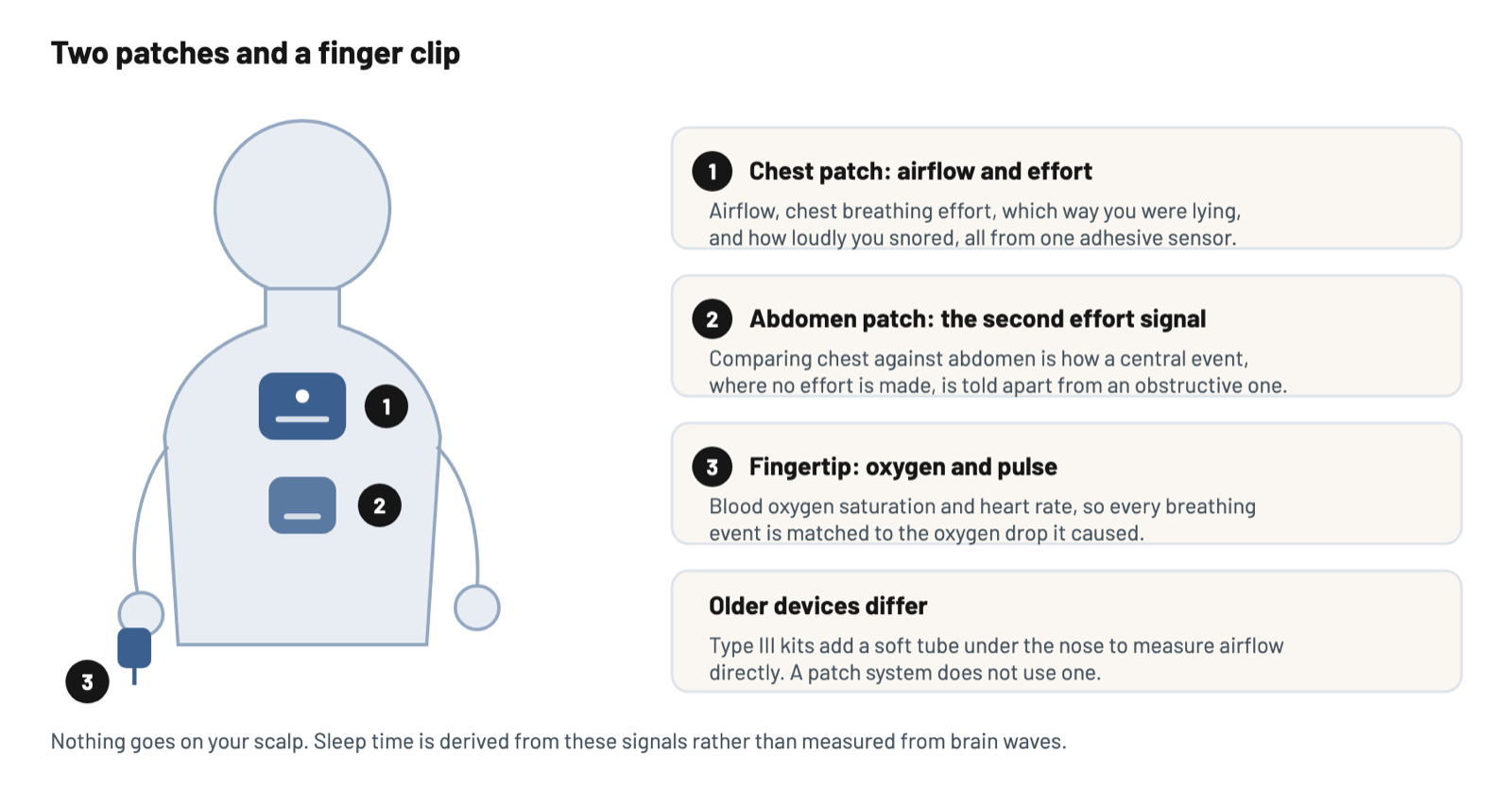
The table above describes the Type III setup. A patch system instead sticks one sensor to the chest and a second to the abdomen, with a pulse oximeter on a finger. Two effort signals rather than one is what lets it tell a central event, where no breathing effort is made, from an obstructive one. The test FixSnoring ships is this newer kind, which is why there is no tube in the box.
What a home sleep test cannot tell you
The missing piece is your brain. A lab study includes EEG electrodes that record brain waves, which is how it knows the moment you fell asleep, which stage you are in, and whether a breathing event pulled you toward waking. No home sleep test records brain waves, whichever kind you get.
Three consequences follow, and they are why a home test is a first step rather than the last word:
- Sleep is estimated, not measured. Devices that track movement can estimate when you were asleep and give a decent approximation of sleep time. Devices with no sleep tracking at all divide your events across everything they recorded, including the hours you lay awake, which pushes the number down
- Arousals go uncounted. Breathing events that fragment your sleep without dropping your oxygen need an EEG to score. No home device can see them, so those events are missing from every home test result
- Other sleep disorders stay hidden. Narcolepsy, periodic limb movement disorder, REM behavior disorder, and seizure activity all need sensors that no home test carries
All three limits push the same way: they make your night look better than it was. A home test underestimates more often than it overstates, which is why a normal result in someone with strong symptoms of sleep apnea does not close the case.
How the process works, start to finish
- Clinical evaluation. A physician, nurse practitioner, or physician assistant reviews your symptoms and risk factors, often using the STOP-BANG questionnaire. The test requires an order from a clinician, whether that visit happens in person or over telehealth
- The device reaches you. Most programs mail it out. Some devices are single-use and disposable, others get returned after the recording
- You set it up at bedtime. Written and video or in-app instructions come with it, and setup runs five to ten minutes. On an older kit that means a tube under the nose, a belt around the chest and a probe on a finger. On a patch system it means sticking two or three sensors in place and switching it on
- You sleep. One night is standard. Some protocols use two or three nights, which improves reliability because event counts vary from night to night
- The data goes back. Either you mail the unit back or the device uploads over an app or cellular connection
- A sleep physician scores and interprets it. A technologist or software marks each breathing event, and a board-certified sleep physician reviews the scoring, checks the recording was technically adequate, and writes the interpretation. This is the step that makes it a diagnostic test rather than a gadget reading
- You get results and a plan. Usually within a few days to two weeks, followed by a conversation about what the number means for you
What is the night itself like?
Less dramatic than people expect, and a little less comfortable than a normal night. On a cannula kit the tube under your nose is the part people notice, mildly irritating for the first twenty minutes, with the belt sitting like a snug chest strap. A patch system has no tube at all, and most people stop noticing it once they settle.
A few things make the recording usable:
- Go to bed at your normal time and sleep in your normal position, including on your back if that is where you usually end up
- Skip alcohol and sedatives that night unless your clinician says otherwise, since both change your breathing and would distort the result
- Keep nail polish off the oximeter finger, because it can interfere with the reading
- If a sensor comes loose in the night, put it back on and go back to sleep. Partial data is usually still scoreable
- Do not skip the test because you think you will sleep badly. Even a poor night's sleep with real breathing events produces a usable recording
Tests do occasionally fail, from a dead battery, a dislodged cannula, or too little recorded sleep. Repeats happen routinely and are not a sign that anything went wrong with you.
How your night becomes a number
Scoring counts two kinds of breathing event. An apnea is airflow essentially stopping for at least 10 seconds. A hypopnea is a partial drop of at least 30 percent for at least 10 seconds, paired with a measurable fall in blood oxygen.
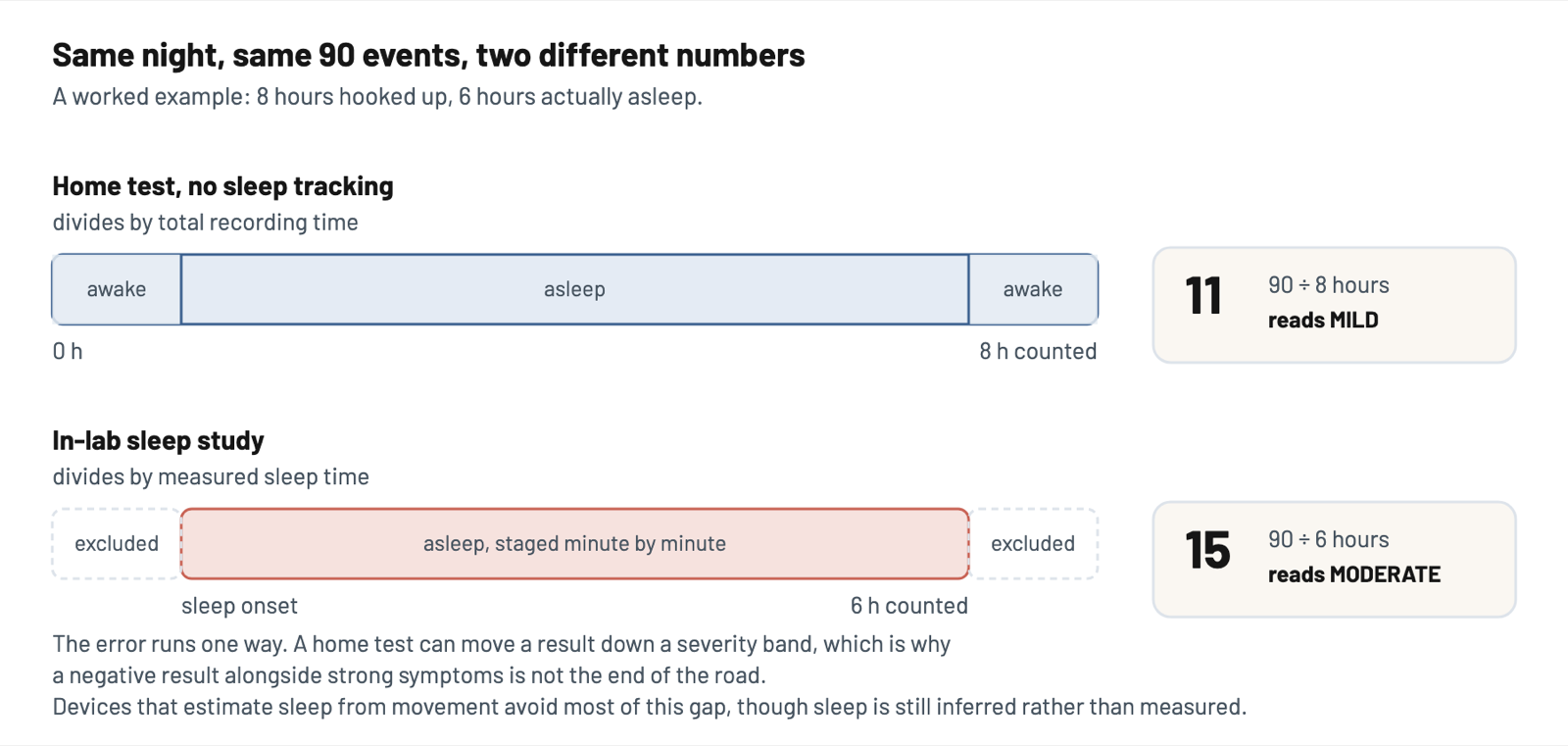
Total events then get divided by hours, and the denominator is where home tests differ from each other. A lab study divides by measured sleep time and reports the apnea-hypopnea index, or AHI. A home device with no sleep tracking divides by everything it recorded and reports a respiratory event index, or REI. Same idea, bigger denominator, smaller number. A device that estimates sleep from movement lands somewhere in between and usually reports an AHI against that estimate.
Here is why it matters. Spend eight hours hooked up but only six asleep, with 90 breathing events, and dividing by recording time gives about 11 while dividing by sleep time gives 15. One reads mild, the other moderate, from one night of data. Worth asking your provider which number your report shows.
| Events per hour | Classification in adults |
|---|---|
| Fewer than 5 | Normal range |
| 5 to 14 | Mild sleep apnea |
| 15 to 29 | Moderate sleep apnea |
| 30 or more | Severe sleep apnea |
Your report will also show how low your oxygen went and how much of the night you spent below 90 percent saturation, which matters as much as the event count for judging how much strain the night is putting on your body.
What happens after your results
Three outcomes are possible, and each has a standard next step.
The test is positive. Your clinician discusses severity, your symptoms, and your other health conditions, then talks through treatment. Treatment decisions belong in that conversation rather than in an article.
The test is negative but your symptoms persist. This is the scenario people handle wrong. Given that home tests underestimate, a normal result alongside a strong symptom cluster usually means an in-lab sleep study, not a conclusion that nothing is happening.
The test is inconclusive or technically inadequate. Too little recording time or bad signal quality means a repeat home test or a move to the lab.
How much does a home sleep test cost?
Self-pay home testing in the United States generally runs from about 100 to 500 dollars, depending on the provider and on whether the physician's interpretation is bundled into the price. The FixSnoring test is 99 dollars flat with the interpretation included, and it is FSA and HSA eligible. An in-lab study before insurance usually runs into the thousands.
Most insurance plans, Medicare included, cover home testing when a clinician documents symptoms consistent with sleep apnea, though many require prior authorization first, which is part of why the direct-pay route is often faster. Two questions worth asking whoever you buy from: is the sleep physician's interpretation included in the quoted price, and what happens financially if the test has to be repeated.
Who should not use a home test?
Home testing is validated for adults with symptoms suggesting uncomplicated moderate to severe obstructive sleep apnea. Several situations call for an in-lab study from the beginning:
- Significant heart failure, coronary disease, or chronic lung disease
- Muscle weakness from a neuromuscular condition
- Suspected underbreathing at night, where carbon dioxide builds up rather than oxygen simply dipping
- Long-term opioid use, which can drive central apneas
- A history of stroke
- Severe insomnia, since very little sleep makes the recording hard to interpret
- Suspicion of a different sleep disorder such as narcolepsy or a movement disorder
- Children, where testing is a specialist matter
The pattern behind that list is straightforward: a home test asks one narrow question well, and anything more complicated than that question needs the fuller picture a lab recording provides.
Common questions about home sleep tests
How accurate is a home sleep test?
For adults with clear symptoms of moderate to severe obstructive sleep apnea, home tests agree with lab studies closely enough that sleep medicine guidelines endorse them as a first-line diagnostic tool. Their error runs in one direction: no home device records brain waves, so arousal-only breathing events go uncounted, and severity comes out low more often than high. That is why a negative result in a strongly symptomatic person leads to an in-lab study rather than a conclusion.
Do I need a prescription?
You do not usually need to arrive with a prescription in hand. A physician still has to be in the loop, so direct-to-consumer providers have you complete a health questionnaire at checkout and a board-certified sleep physician reviews your data and issues the diagnosis afterward. Consumer gadgets with no clinician involved can flag a concern but cannot diagnose sleep apnea.
What if I sleep badly during the test?
Usually it still works. Scoring needs a reasonable stretch of recorded sleep rather than a perfect night, and a restless night with real breathing events still produces usable data. Very little sleep at all can make a test inconclusive, which means a repeat.
How long does it take to get results?
Most people get results within a few days to two weeks, depending on how quickly the device is returned and how the provider schedules interpretation. Devices that upload automatically tend to be at the faster end. The delay is mostly the physician review, which is the part that makes the result diagnostic.
Will one night be enough?
One night is the standard protocol and it is adequate for most people. Breathing event counts do vary from night to night, and sleeping position or alcohol can shift a borderline result, so some providers record two or three nights for better reliability. If your result sits right at a severity boundary, ask whether a second night is worth doing.
Does home testing detect central sleep apnea?
Devices with a chest or abdominal effort belt can often distinguish central events, where no breathing effort is made, from obstructive ones, where effort continues against a closed airway. Devices relying only on a finger sensor are weaker at that distinction. Suspected central sleep apnea is generally a reason for an in-lab study.
What to do next
A home test answers a narrow question well: how often does your breathing stop, and how far does your oxygen fall when it does. It will not tell you how you slept, and it will not rule out every sleep disorder. For someone who snores, wakes up exhausted, and wants to know whether an airway problem is behind it, that narrow answer is the one that changes what happens next.
If your symptoms line up, book a home sleep test and get the measurement. The National Heart, Lung, and Blood Institute has more background on sleep studies of every type.
This article is for general education and is not medical advice. Sleep apnea can only be diagnosed by a licensed clinician using a sleep study they order and interpret.