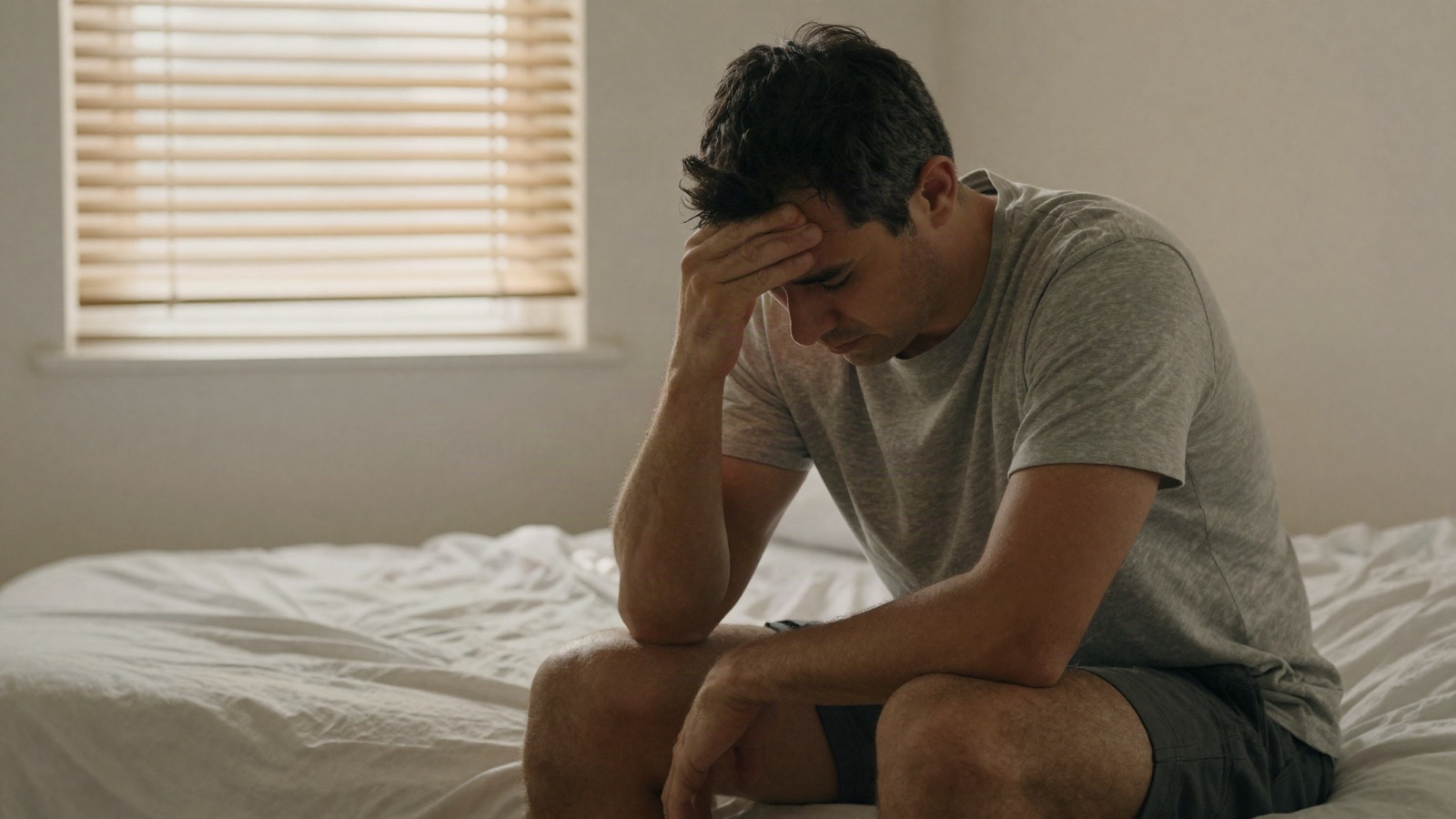
The classic sleep apnea symptoms are loud snoring, breathing pauses someone else notices, gasping or choking awake, and waking unrefreshed after a full night in bed. During the day it surfaces as heavy sleepiness, morning headaches, poor concentration, and a short temper. Many people also get up to urinate two or more times a night.
Sleep apnea is unusual among common conditions in that the main event happens while you are unconscious. You do not experience the apneas. You experience the wreckage they leave behind, which arrives disguised as ordinary problems: exhaustion, brain fog, a headache, a bad mood, a trip to the bathroom at 3am.
That disguise is effective. A widely cited analysis of a large sleep cohort found that 82 percent of men and 93 percent of women with moderate to severe sleep apnea had never been diagnosed. Awareness has improved since that research was published in the 1990s, and the condition is still missed constantly, usually because the symptoms get attributed to stress, aging, low iron, depression, or simply not sleeping enough.
Below is the full symptom picture, at night and during the day, along with the presentations that get overlooked and the point at which it makes sense to measure instead of wonder. If your main concern is specifically whether your snoring is the problem, the seven signs that snoring is sleep apnea covers that narrower question. This page covers adults. Symptoms in children look different enough that they need their own discussion.
Nighttime sleep apnea symptoms
These are the symptoms produced directly by a collapsing airway. Most of them are easier for a partner to spot than for you.
| Symptom | Why it happens |
|---|---|
| Loud, chronic snoring | Air forcing past tissue in a narrowed airway. Often described as louder than talking, and audible through a closed door. |
| Witnessed pauses in breathing | The airway closing off. Usually reported by a bed partner as silence that goes on uncomfortably long. |
| Gasping, snorting, or choking awake | The arousal that reopens the airway at the end of an event. |
| Waking repeatedly for no clear reason | Each breathing event ends in a brief arousal. Most are too short to remember, but some surface as full awakenings. |
| Getting up to urinate twice or more | Pressure swings in the chest during a blocked breath trigger a hormone that tells the kidneys to make more urine. |
| Dry mouth or sore throat on waking | Hours of mouth breathing because the nose alone cannot supply enough air. |
| Night sweats | Repeated surges of adrenaline through the night. |
| Restless, thrashing sleep | The body moving in response to arousals and oxygen dips. |
| Teeth grinding | Associated with apnea in a meaningful share of cases, possibly as part of the arousal response. |
| Heartburn at night | Negative pressure in the chest during an obstructed breath can pull stomach acid upward. |
Nocturia is the one that surprises people most. Being woken by breathing and interpreting it as needing the bathroom is extremely common, and a man in his fifties usually blames his prostate before he blames his airway.
Daytime symptoms people never connect to their sleep
Daytime symptoms come from sleep that was technically long enough and functionally useless. You spent eight hours in bed and almost none of it uninterrupted, and the deficit turns up everywhere.
- Unrefreshing sleep. Waking up as tired as when you went to bed, every day, regardless of hours slept
- Excessive daytime sleepiness. Fighting sleep while reading, in meetings, watching television, or at a red light
- Morning headache. Typically across the forehead, present on waking, gone within an hour or two
- Trouble concentrating. Losing the thread mid-task, rereading the same paragraph, forgetting names
- Irritability and mood changes. A shorter fuse, flatness, or anxiety that has no obvious source
- Memory lapses. Particularly for recent things, since fragmented sleep interferes with consolidating them
- Reduced libido or erectile dysfunction. Common enough that urologists screen for apnea
- Falling asleep in the car. The symptom with the highest immediate stakes, and the one to raise with a doctor first
Sleepiness and fatigue are not the same thing, and the difference matters at the doctor's office. Sleepiness is the pull toward actually falling asleep. Fatigue is being drained without being able to nod off. Apnea causes both, but people who report fatigue instead of sleepiness get screened for it far less often.
Why one condition causes such scattered symptoms
Every one of those symptoms traces back to a single repeating event. Your airway narrows or closes, airflow drops or stops, blood oxygen falls, and carbon dioxide climbs. Your brain notices, fires off a burst of adrenaline, and jolts you toward wakefulness just enough to reopen the throat. You take a gasping breath and drop back down.
Then it happens again. Someone with moderate apnea runs through this cycle 15 to 29 times an hour. Someone with severe apnea can exceed 30 an hour, which works out to more than 240 events in an eight-hour night.
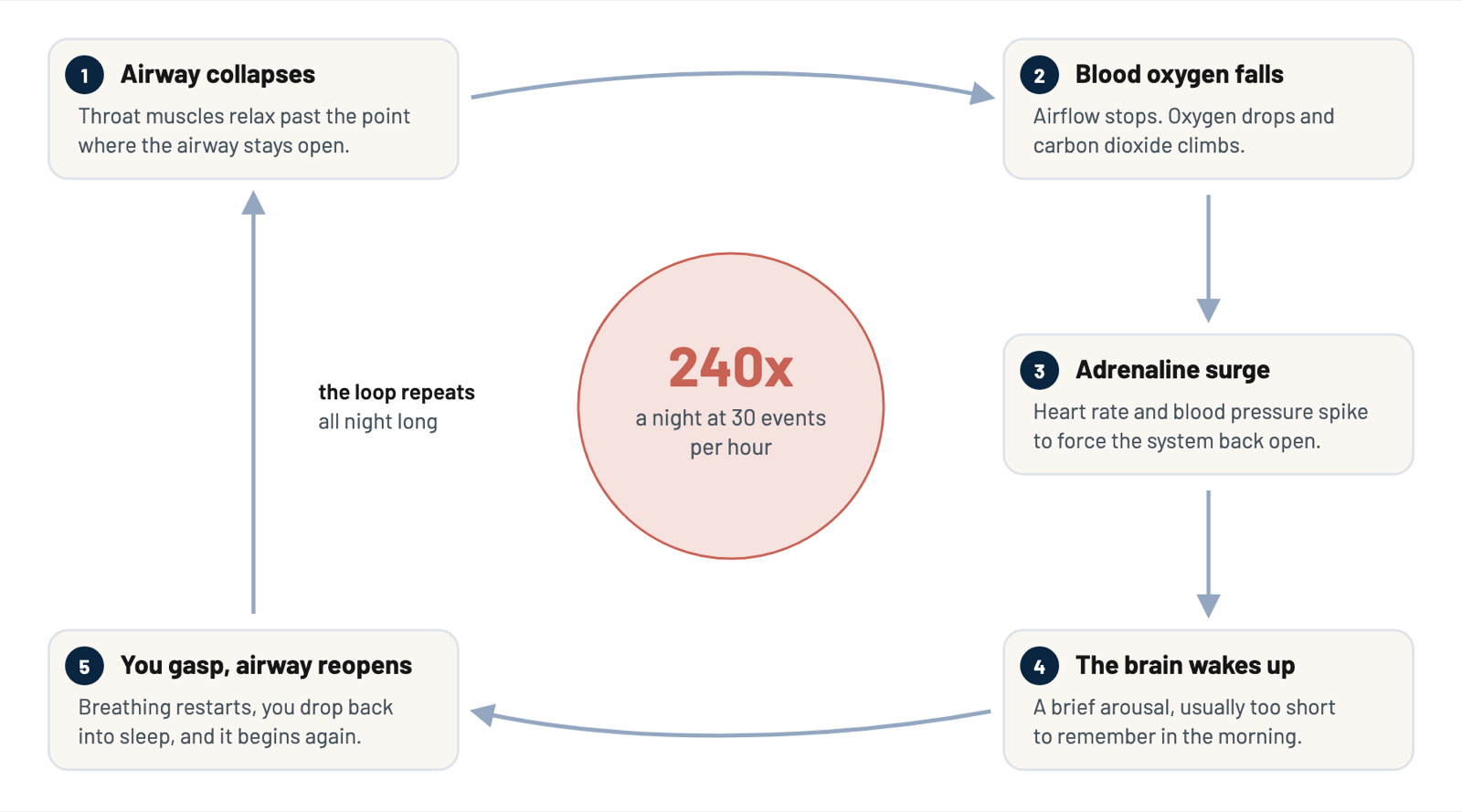
Two separate injuries come out of that loop. The first is fragmentation: sleep chopped so finely that deep and REM stages never properly consolidate, which produces the fog, the mood changes, and the memory problems. The second is intermittent oxygen dipping paired with repeated adrenaline surges, which is the pathway linking untreated apnea to high blood pressure, atrial fibrillation, stroke, and type 2 diabetes.
Understanding the mechanism explains something confusing about this condition. The symptoms are downstream effects, so their severity does not reliably track the number of events. Some people with an event count in the severe range feel reasonably fine. Others in the mild range feel destroyed. Symptoms tell you to investigate, and they do not tell you the answer.
Why sleep apnea symptoms look different in women
Women with sleep apnea are less likely to present with the textbook trio of loud snoring, witnessed apneas, and daytime sleepiness, and more likely to arrive with insomnia, fatigue, morning headaches, anxiety, or low mood. Same condition, different-looking complaint.
That difference has a cost. Those symptoms map neatly onto depression, anxiety, thyroid problems, perimenopause, and chronic fatigue, so women often get worked up or treated for one of those first. Trouble falling and staying asleep in particular reads as insomnia, and insomnia treatment does nothing for a collapsing airway.
Two practical points. Risk rises substantially after menopause, as estrogen and progesterone decline and upper airway muscle tone drops with them. And a woman sleeping alone has no one to witness her breathing pauses, which removes the single most persuasive symptom from the conversation.
The presentations that get missed most
Two groups get told they cannot have sleep apnea and turn out to have it.
Quiet sleepers. You can have significant obstructive sleep apnea without much snoring, and central sleep apnea, where the brain briefly stops sending the signal to breathe, usually involves no snoring at all. Absence of noise is not absence of events. If you want the mechanics of the sound itself, see why you snore.
Thin people. Weight is a major risk factor and it is nowhere near the only one. A substantial minority of people diagnosed with sleep apnea are not overweight, and their airways are compromised structurally instead: a set-back or small lower jaw, a high narrow palate, enlarged tonsils, a deviated septum, or chronic nasal obstruction. A normal BMI lowers your risk and does not clear you.
Age and family history belong here too. Risk climbs through middle age for everyone, and having a first-degree relative with sleep apnea raises yours independently of your weight.
What AHI means, and how it maps to symptoms
Sleep studies report severity as the apnea-hypopnea index, or AHI: the average number of breathing events per hour of sleep. An apnea is airflow essentially stopping for at least 10 seconds. A hypopnea is a partial drop of at least 30 percent lasting at least 10 seconds, together with a fall in blood oxygen or a brief arousal.
| AHI in adults | Classification |
|---|---|
| Fewer than 5 events per hour | Normal range |
| 5 to 14 | Mild sleep apnea |
| 15 to 29 | Moderate sleep apnea |
| 30 or more | Severe sleep apnea |
Treat those bands as a description of how often your breathing is interrupted rather than a score for how bad you should feel. Symptom burden, oxygen levels, and other health conditions all factor into what a clinician recommends, which is why the number gets interpreted by a person rather than read off a chart.
Should you get tested?
Testing makes sense when several symptoms cluster together, and particularly when someone has witnessed you stop breathing, when you are sleepy during the day despite adequate time in bed, or when you have high blood pressure that resists treatment. One symptom in isolation is usually not enough on its own.
Clinicians often start with a screening questionnaire called STOP-BANG, which asks about snoring, tiredness, observed apneas, blood pressure, body mass index, age, neck circumference, and sex. A score of 3 or higher flags intermediate risk and 5 or higher flags high risk, and our two-minute risk quiz covers the same ground. This is a risk screen, not a diagnosis. It sorts who should be tested, and it cannot tell you whether you have sleep apnea, and no online quiz can either.
The usual next step is a home sleep test, ordered by a clinician. You sleep in your own bed wearing a recorder that tracks airflow, breathing effort, blood oxygen, and pulse, and a physician reads the data and produces your event count.
Its limits deserve stating. No home device records brain waves, so breathing events that fragment your sleep without dropping your oxygen cannot be scored, and older devices with no sleep tracking dilute the count further by dividing across the hours you lay awake. Either way the result underestimates severity more often than it overstates it. A negative home test in someone with a strong symptom cluster does not settle the matter, and the normal next move is a full in-lab sleep study.
Some situations skip the home test entirely: significant heart or lung disease, muscle weakness from a neuromuscular condition, suspected underbreathing at night, long-term opioid use, previous stroke, or a suspicion of a different sleep disorder such as narcolepsy. Those need in-lab testing from the start.
Common questions about sleep apnea symptoms
What are the first signs of sleep apnea?
The earliest signs are usually loud habitual snoring and waking up unrefreshed after a full night in bed. A bed partner often notices pauses in breathing or gasping before the person with apnea notices anything at all. Morning headaches and daytime sleepiness tend to follow as the condition progresses.
Can you have sleep apnea and not feel tired?
Yes, and it is more common than people expect. Symptom severity does not track event count reliably, so some people with moderate or severe sleep apnea report feeling reasonably well. Others become so used to the tiredness over years that they no longer register it as abnormal.
What are the symptoms of sleep apnea in women?
Women more often report insomnia, fatigue, morning headaches, anxiety, and low mood rather than the classic loud snoring and daytime sleepiness. Those symptoms overlap heavily with depression, thyroid disease, and perimenopause, which is a major reason sleep apnea in women is diagnosed later. Risk also increases after menopause.
Why do I wake up gasping for air?
Gasping awake is the arousal that reopens a closed airway, and it is one of the more specific symptoms of obstructive sleep apnea. Anxiety, acid reflux, and heart conditions can cause similar awakenings, so it needs proper evaluation. Waking up gasping more than occasionally is worth raising with a doctor promptly.
Does sleep apnea cause weight gain?
The relationship runs in both directions. Extra weight raises apnea risk, and untreated apnea disrupts the hormones governing appetite and makes exercise harder by leaving you exhausted. That feedback loop is one reason weight-focused advice alone often fails until the breathing is addressed.
Can a smartwatch or ring detect sleep apnea?
Consumer wearables can flag patterns worth investigating, such as dips in blood oxygen or restless sleep, and some now carry sleep apnea notification features. None of them can count breathing events the way a diagnostic device does, and none can diagnose the condition. Treat a wearable alert as a reason to get properly tested.
What to do next
If you recognized a cluster of these symptoms rather than one, the useful next move is measurement. Symptoms point at sleep apnea, and only a sleep study can confirm it and say how often your breathing stops. The American Academy of Sleep Medicine keeps a plain-language overview if you want the clinical framing before you act.
The fastest route from a symptom list to an actual number is one night with a recorder in your own bed. Order a home sleep test and stop guessing which of these symptoms belongs to your airway.
This article is for general education and is not medical advice. Sleep apnea can only be diagnosed by a licensed clinician using a sleep study they order and interpret.